> For the complete documentation index, see [llms.txt](https://docs.plummerindustries.com/llms.txt). Markdown versions of documentation pages are available by appending `.md` to page URLs; this page is available as [Markdown](https://docs.plummerindustries.com/drive-systems/drive-corners/standard-features.md).
# Standard Features
In the Drive Corner family of products there are some design features that stay the same across all models and options.
## Motor Compatibility
#### Drive
Since the Drive Motor is mounted on a separate mount for easy removal and maintenance we can make almost any drive motor compatible with the system. Currently there are two options for the motor mounts REV and KRAKEN. The REV covers all standard length 8 mm shaft motors including Neo, Neo 2, and Neo Vortex. The Kraken Mount is for extra length of the Kraken Shaft.
#### Steering/Azimuth
We have included 3 distinct bolt patterns in the upper plates for maximum motor acceptance. Currently they are compatible with Neo, Neo 2, and Minion Motors. As well as Vortex, Kraken X60 and Kraken X44 but they hang lower than the lower plate. This also means in case of motor failure you can switch to any other motor without changing plates.
## Corner Bolt Pattern
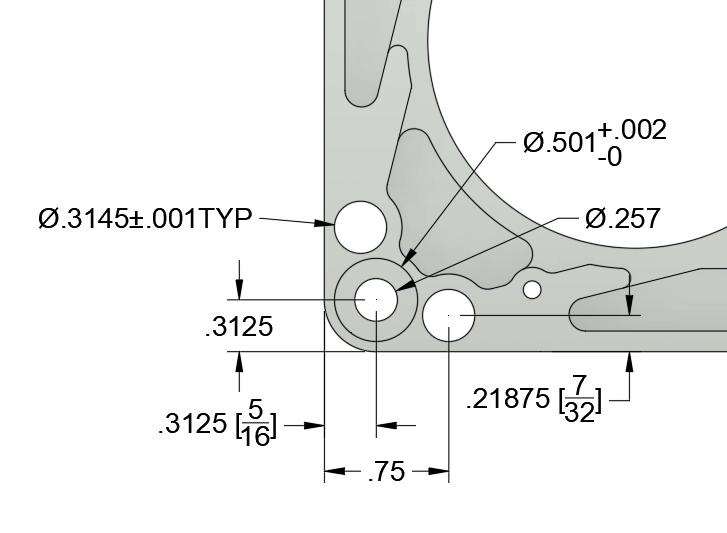
On the corner of every one of our plates there is a pattern of holes that can be used for a variety of attachments. Below is the specifications of that pattern. We use this pattern in our manufacturing process but it comes in handy to mount lifting hooks or other team made attachments. There is a list of our attachments [**HERE**](/drive-systems/drive-corners/other-options-and-extras.md).
## Plate Thickness
Our plates are 5/16 Thick 6061 - T6 across the DC lineup to give them the strength they need without having to turn to 7075 aluminum as an alternative. This leaves them weldable in a full failure situation and less likely to snap if pushed past Yield Strength. At the same time the plates see considerably less point loading due to the wheel mount having such a large contact area on the bushing.
## Frame Height and Pattern
We wanted to give teams the option to switch between plate options after their frame had been built. So the bolt patterns between plates are identical. If you wish to switch between plates that are open corner you don't need to manufacture new frame segments.
## Design Principles
When designing the Drive Corner we put a lot of thought into possible failures that could cost teams matches and you can see that in some of the design choices. Below is some of our reasoning and design decisions.
### "Small" Wheel
We decided to use a small wheel for a couple reasons, total weight, spinning mass, and total size. With a smaller wheel the wheel simply will weigh less than a larger one. That mass is on a smaller diameter so will be more efficient to turn. The wheel allows the drive motor to be mounted lower and reduce the total height of the module. The small wheel also means that we need less gear ratio to attain reasonable speeds. Less gear ratio is advantageous for a few reasons. Less losses in the friction of the gears and any changes in gear teeth have a more meaningful affect on the ratio(and therefore speed) which make the differences in ratios more pronounced.
Since the wheel has less circumference the robot travels less per turn of wheel. This means that odometry is less changed by wheel wear compared to larger wheels and will be more consistent over the life of the wheel.
The smaller size of the wheel also lets us "push" the wheel further out into the corner of the robot chassis. This provides an even greater wheelbase and leads to more stability and performance overall.
There are disadvantages to this small of a wheel as well. There is simply less surface area of traction material so wheel life is less. With a small wheel going over large obstacles is also considerably more difficult.
### Bushing vs Bearing
The Swivel rides entirely on a set of IGUS bushings. This is for a few reasons. The bushings allow us to simplify the way we constrain the swivel to the lower plate. The bushings are lighter and less susceptible to failure under impact loading. The speed and loading scenario that the azimuth is under lends itself more to a bushing than a bearing.
### Bolts are not loaded in shear
Throughout the entire module there are no bolts that take any shear loading. There are two reasons for this. Threads on bolts will wear out the holes they go though if they are subject to shear loading and bolts that take shear loading will loosen over time. Even if the bolts come loose they aren't required and nothing on the module will fail. This can be seen in a few of the below locations.
#### Swivel Assembly
There is an 1/8 inch pin that takes the load of steering the swivel. While the swivel is held together by 4 #10-32 bolts all of them could be loose and the module would still function with no damage.
#### Wheel Miter Gear
The Miter Gear interfaces with the wheel with dogs to transfer all torque. Because of where the miter gear installs in the system all three bolts don't even have to be there to function. They only hold the gear in place when the wheel is removed.
### Weight Lightening
When designing all of the parts on the Drive Corners weight was one of our main concerns. We removed as much weight as possible within reason. One of the places you can see this is the upper and lower plates where we pocketed from both sides instead of all the way through. This allows maximum material removal while still keeping paths for foreign objects into the system at a minimum.
### Enclosed Gear Train
All gears are enclosed in aluminum housings to prevent dirt ingress and gears flinging grease onto other parts of the robot.
### Belt Based Steering
Belts are lighter, cleaner, and quieter than gears. They also allow for less backlash over time and a "tighter" system overall. Belt systems need to be properly designed to function, too little teeth engaged on pulley, imperfect pulley profile, and back bending of the belt are detrimental to belt systems. As long as belts are tensioned properly and don't get damaged by external factors they often last longer than gears.
### Combined Components
During the design process we combined components when possible and reasonable. While this creates more specialized parts, it lowers overall part count, reduces weight, increases reliability, and decreases interfaces that can create error in odometry measurements.
### Parts Availability
While a lot of the parts of the Drive Corners are specialized there are quite a few that can be directly replaced with commonly available FRC components that teams already have. This allows lost parts and failures to be remedied quickly at a competition. See this section [**HERE**](/drive-systems/drive-corners/emergency-repair/replacment-parts.md) for a list of compatible parts.
### Parts Compatibility
Almost all of the configurations use the same components. This was one of our goals so teams could switch just the plates and get an entirely new configuration of swerve that fits their needs for their specific use case. This means less spares are needed and teams can reuse the expensive components year after year without having to be stuck into a certain configuration.
---
# Agent Instructions
This documentation is published with GitBook. GitBook is the documentation platform designed so that both humans and AI agents can read, navigate, and reason over technical content effectively. Learn more at gitbook.com.
## Querying This Documentation
If you need additional information that is not directly available in this page, you can query the documentation dynamically by asking a question.
Perform an HTTP GET request on the current page URL with the `ask` query parameter, and the optional `goal` query parameter:
```
GET https://docs.plummerindustries.com/drive-systems/drive-corners/standard-features.md?ask=&goal=
```
`ask` is the immediate question: it should be specific, self-contained, and written in natural language.
`goal` is optional and describes the broader end goal you are ultimately trying to accomplish on behalf of the user. GitBook uses it to tailor the answer towards what is most useful for that goal.
The response will contain a direct answer to the question and relevant excerpts and sources from the documentation.
Use this mechanism when the answer is not explicitly present in the current page, you need clarification or additional context, or you want to retrieve related documentation sections.